
Lake Nakuru National Park
Lake Nakuru National Park is located in Nakuru County, within the Rift Valley Region, south of Nakuru town in Kenya. This National Park is a remarkable wildlife & Birding safari destination in Kenya, famed for its millions of pink flamingos that flock it’s alkaline lake. Lake Nakuru National Park is one of the most popular safari destinations on Kenya itineraries, especially for bird lovers and wildlife enthusiasts. Renowned for its breathtaking landscapes, diverse ecosystems, abundant wildlife, and world famous birdlife, the park attracts hundreds of thousands of visitors seeking an unforgettable Kenya safari experience each year.
The protected wilderness of Lake Nakuru National Park is an expansive park resting on a land mass of close to 188 km², encompassing woodlands, grasslands, cliffs, savannas, and the alkaline lake. The alkaline Lake Nakuru covers approximately 45 square kilometers (17 square miles) of the total 188 square kilometers that the park encompasses. It is, however, important to note that the lake’s size varies depending on the season. Lake Nakuru National Park is one of the most accessible national parks in Kenya and fits perfectly into longer itineraries that include the Masai Mara National Reserve, Amboseli National Park, Lake Naivasha, or Samburu National Reserve.
This National Park is one of the best places in Kenya to combine wildlife viewing and Bird watching on a single tour. Lake Nakuru National Park is famous for its millions of Flamingos that flock to the shores of its alkaline lake. There are also several other bird species in the park, especially water birds like the African spoonbill, and African fish eagle, making it one of the best destinations for birding in Kenya.
The National Park is also a top destination for wildlife viewing in Kenya, boasting a healthy population of wildlife all year round. This National Park hosts four of the African Big Five animals (lion, leopard, rhino, and buffalo), and several other wildlife species including; Giraffes, waterbucks, zebra, warthog, wildebeest, hippos, olive baboons, and spotted hyenas among others.
Although Lake Nakuru was once famous for its millions of Pink flamingos that painted the shoreline pink, over the years, Lake Nakuru National Park has evolved into one of Kenya’s finest destinations for Big Five safaris (rhino, buffalo, elephant, lion, & leopard), rhino conservation, birdwatching, and family friendly wildlife adventures.
Whether you are a first time traveler, on a family holiday, a romantic honeymoon safari, or a luxury wildlife adventure, Lake Nakuru National Park delivers exceptional wildlife and bird spotting throughout the year.
History of Lake Nakuru National Park, Kenya
The conservation History of lake Nakuru National Park dates back several decades. The area was first recognized for its exceptional birdlife, particularly its massive flamingo populations, making it one of the world’s greatest birdwatching destinations.
The history of Lake Nakuru National Park explains the story of destruction to conservation, which transitioned from game hunting in the 1950s to conservation to protect endangered animal species and other wildlife around this area. Birding viewing was a common aspect from the colonial times around the area of Lake Nakuru National Park, with watchers coming from as far as Europe. The huge numbers of flamingos on Lake Nakuru were the most of birding attraction.
The hunting practices created pressure on the wildlife in the area, which called for the setting up of a conservation area in 1957 to conserve wildlife like rhinos, elephants, among others, which allowed for animal numbers to grow.Then in 1961, the southern area of Lake Nakuru was gazetted as a bird sanctuary to protect its fragile ecosystem. Due to increasing wildlife populations and the need for stronger conservation measures, the sanctuary was upgraded to Lake Nakuru National Park in 1968.
In the 1980s, the Rothschild Giraffes and Rhinos were introduced in lake Nakuru National Park in an effort by the government to conserve the endangered Rhinos in the country due to poaching, thus making lake Nakuru National Park the first designated Rhino sanctuary in Kenya. To further more to protect the rhinos from poachers, in 1986, the Kenyan government fenced 188 sq km to help keep poachers away from lake Nakuru National Park and also keep the endangered Rhinos within the boundaries of the Park.
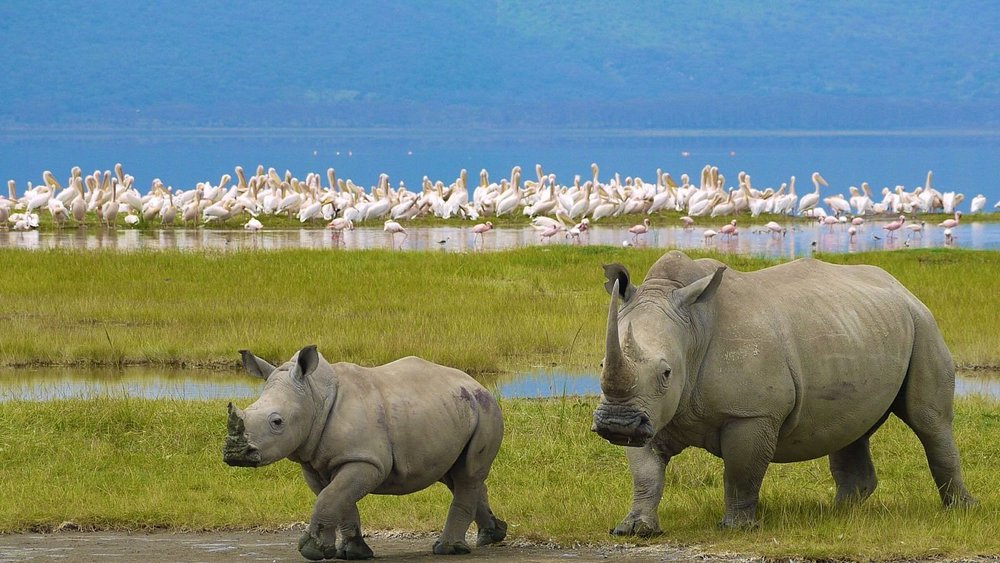
Lake nakuru-national-park rhinos
Where is Lake Nakuru National Park Located?
Lake Nakuru National Park is located in the Eastern arm of the Great Rift Valley ( also known as the Gregory Rift) in Nakuru County. Lake Nakuru is in the south of Nakuru Town and about 100 miles( 160 km) North West of Nairobi city. The park sits on the Rift Valley floor at an elevation of about 1754 meters above sea level, and it’s primarily accessed through the main gate which is about 4km from Nakuru Town.
Distance of Lake Nakuru National Park from Major cities.
- Nairobi city to Lake Nakuru National Park: Approximately 160km (100 miles) – 3 hours’ drive
- Naivasha Town to Lake Nakuru National Park: Approximately 80km ( 50 miles) – 1 hour 30 minutes’ drive
- Masai Mara National Reserve to Lake Nakuru: Approximately 192km(119 miles) – 4 hours’ drive ( depends on the gate of entry as well)
- Amboseli National Park to Lake Nakuru National Park: Approximately 380 km(236 miles) – 8 hours’ drive
Top Attractions in Lake Nakuru National Park
- Flamingos of Lake Nakuru
Lake Nakuru is the flamingo capital of Africa, with flamingos swarming through the skies and covering large portions of the shores. Blue meets pink at Lake Nakuru National Park as the blue waters are shaded by the pink covering of the flamingos, which gives the impression of a pink blanket on the water. Most of the day, the flamingos are visible and millions of them can be seen by birders. Flamingo watching is a good adventure, merged with other cool wildlife viewing adventures like Big Five safaris in Lake Nakuru National Park.
- Lake Nakuru
Lake Nakuru is one of the main attractions of the Park that captures the attention of most travelers, and it’s the park’s main feature, plus it’s where the park derives its name from. A wildlife haven has been felt around Lake Nakuru with about 50 mammals and 450 birds roaming around the area, which makes it a key center for an authentic African Safari and Big Five safari experience, as lions, leopards are some of the animals to see.
The lake’s fame comes from the huge number of Flamingo birds that can be spotted all year round on the Lake Nakuru shoreline. Flamingos are more than usual while at Lake Nakuru and it is the best place to see lesser flamingos in the world, making it a popular birding destination. These flamingos can be observed from various viewpoints across the national park, including the Baboon Cliff and Lion Hill. Boat Safaris are part of the long list of activities on offer here.
- The Wildlife of lake Nakuru National Park
This wildlife safari Park is indeed a wildlife encampment harboring a diverse number of animals and birds. Visitors can see over 50 mammal species on the game drive through the grasslands filled with rhinos, elephants, hyenas, and hippos, together with the Big Five animals. Sighting animals in the park is as much fun as the animal encounters, which are usually spectacular. Plenty of the Big Five are spotted in the grasslands, and small animals are mostly seen during the walking safaris. Makalia Camp is adored by leopard lovers, offering them regular sightings of leopards while at Lake Nakuru National Park.
Being a rhino sanctuary, the park is home to both black and white rhinos. Lake Nakuru now boasts approximately 150 rhinoceros divided between black and white rhinos. The park is surrounded by an electric fence, which protects the rhinos from poachers who would kill them for their horns. This electric fence also keeps rhinos from wandering out of the park. Lake Nakuru National Park is well known for its high numbers of baboons which can be seen at the Baboon Cliffs.
- Birds
Lake Nakuru National Park is a fantastic habitat for birds and is ranked one of the top birding sites in Kenya. Birders from all over the world should visit this when it comes to bird watching in Kenya. The National Park’s fame is due to the millions of pink flamingos that occupy the shores of its alkaline lake. Kenyan authorities established a bird sanctuary in the southern part of the Park, making it a recommended birding destination with up to 400 species of birds to spot. The most famous of the birds are the lesser flamingos forming a pink pattern on the surface of Lake Nakuru. Other birds that visitors love to watch at Lake Nakuru National Park during Kenyan Safaris include: the white-faced whistling duck, fulvous whistling duck, Macco Duck, Egyptian Goose, Southern Pochard, Tufted Duck, Garganey, African Black Duck among others.
Other notable bird species in Lake Nakuru National Park include; Lappet-faced vulture, Lesser kestrel, Long-tailed widowbird, Maccoa duck, Slender-billed greenbul, Montane white-eye, Northern Puffback, Western reef heron, Pallid harrier, Shining sunbird, Red-capped lark, Rufous-throated wryneck, Rüppell’s vulture, Rüppell’s robin-chat, Schawlow’s wheatear, Sooty falcon,
- Baboon cliff
Baboon Cliff is the most popular viewpoint in Lake Nakuru nation park, providing the most spectacular perspective of the entire valley. It derives its name from the large numbers of baboon troops that wander the clifftop.
Best things to do in Lake Nakuru National Park
- Game Drives in lake Nakuru National Park
Lake Nakuru National Park is home to a variety of wild game and is ideal for wildlife spotting. Morning and evening game drives provide the highest chances of spotting wildlife, and professional tour guides help to locate the elusive animals and explain their behavior and survival. The game drive in Lake Nakuru National Park gives an opportunity to the visitors to view the park’s common animals such as, Lions, buffalo, Rhinos, leopards, antelopes, zebras, among others.
- Rhino tracking in Lake Nakuru National Park
In the 1980s, the Kenyan government designated Lake Nakuru National Park as a Rhino sanctuary till to date, making it one of the best places to see Rhinos while on a Kenyan safari. Each year, thousands of travelers go to Lake Nakuru National Park to track rhinos. Although tracking is conducted by vehicle, visitors enjoy remarkably close sightings of both black and white rhinos.
- Bird watching in Lake Nakuru National game park.
Lake Nakuru National Game Park is inhabited by over 500 species of birds, including the pink Flamingo birds that paint lake Nakuru shoreline pink, giving it the nickname of the “Pink Lake”. The national park is also referred to as the Birders’ paradise for its incredible biodiversity of birdlife.
- Camping in Lake Nakuru National Park.
Lake Nakuru National park is one of the best camping sites in Kenya it offers campers the opportunity to spend a night under the stars and presents visitors a chance to view a few animals up close.
What’s the best time to visit Lake Nakuru?
Just like most safari parks and Reserves in Kenya, Lake Nakuru National Park can be visited all year round. However, some months of the year offer the most ideal conditions for safaris in the park. The dry months or dry seasons are the best time to visit this safari park. There are two dry seasons in Kenya at large; the long dry season between June and September and the short dry season that lasts between December and February.
The best time to visit Lake Nakuru is therefore either between June to September or between December to February. During these month of the year, the track in the park are very accessible and wildlife viewing is at its best. The weather is also favorable for safaris during these months.
Why visit Lake Nakuru National Park?
This Park is the best place to do a Kenyan birding safari, the only place where you can see a large number of birds – up to one million at once. Safaris here combine a number of safari activities, including game drives, nature walks, and boat safaris on a single journey.
The national park is the flamingo capital of Kenya and perhaps Africa at large – millions of these birds flock at the lake shores creating a stunning array. The natural contrast between blue water and pink lesser flamingos creates a natural spectrum which is a rainbow of its own.
Lake Nakuru Park is located within the Rift Valley and there are riff valley escarpments which create stunning scenery and host several wildlife species. Places around the Great Rift Valley are photogenic, and beautiful landscapes can be seen everywhere around the Park.
How to get to Lake Nakuru National Park
The Park can be reached using both road transport and air transport, depending on the time and budget of the visitors.
By Road;
From Nairobi city, a car drive takes about 3 hours heading 155 kilometers northwest towards Nakuru Town. The main gate for Lake Nakuru National Park is a 33-minute drive over 5 kilometers from Nakuru Town. Driving from Masai Mara National Reserve takes about 4 to 6 hours to reach Nakuru Town over 235 kilometers of road. From Samburu Game Reserve, a drive towards Nakuru Town takes about 6 hours along the 300 km highway.
By Air;
A charter flight from Jomo Kenyatta International Airport in the capital, Nairobi, takes about 45 minutes to reach Nakuru. From there, visitors can get into a 4×4 vehicle to reach Lake Nakuru National Park.